Hidden Costs of a Mini Skid Steer – Full-Size Owners Never Pay These Bills
Hidden Costs of a Mini Skid Steer – Full-Size Owners Never Pay These Bills
Table of Contents
- 1. Attachment Compatibility Fees
- 2. Higher Hourly Operating Cost
- 3. Rental Frequency for Big Jobs
- 4. Faster Undercarriage Wear
- 5. Lost Revenue from Slower Jobs
- 6. Frequent Hydraulic Fluid Changes
- 7. Lower Resale Value After 1,000 Hours
- 8. Should You Buy a Mini Skid Steer?
- 9. How to Avoid These Extra Expenses
You bought a compact loader to save money. You thought smaller means cheaper. The machine costs less upfront, fits perfectly in tight spaces, and tows easily behind a standard truck. But the hidden costs of a mini skid steer quietly eat away at your profits. Full-size skid steer owners manage to avoid these frustrating bills completely. This guide will show you exactly where your hard-earned money disappears.
A smaller loader looks like a bargain on paper, and the price tag feels good. However, the operational expenses tell a entirely different story. Many contractors end up switching back to full-size machines after just one year because they discover the hidden costs of a mini skid steer entirely too late. Do not make the same mistake. Before making a purchase, make sure to read everything to know before buying the TYPHON or any other compact machine to protect your bottom line.
Attachment Compatibility Fees
A compact machine uses a different attachment plate than larger models. Full-size skid steers use universal standard plates, meaning you can swap attachments seamlessly between brands. Compact models, however, often require proprietary adapters. Each adapter costs between $400 to $1,200. You pay this frustrating fee for every single attachment you own.
Imagine you already own $15,000 worth of attachments from your old machine. Suddenly, none of them fit. You must either buy expensive adapters or replace the attachments entirely. This is one of the most surprising hidden costs of a mini skid steer. Full-size owners never pay this fee because they keep using their existing attachment library without issues.
⚠️ The Adapter Trap
A contractor in Texas owned six attachments for his full-size machine. When he bought a compact loader, he spent $3,800 on adapters alone. Then he discovered some attachments still didn’t work correctly because hydraulic flow rates differ drastically. Running an auger or trencher at the wrong speed directly adds to the hidden costs of a mini skid steer.
Higher Hourly Operating Cost Per Yard Moved
A smaller loader moves significantly less material per hour. You pay the same operator wage, and you pay the same fuel cost per hour, but you move half the dirt. Your cost per cubic yard essentially doubles. Full-size owners move much more material in the exact same timeframe.
Here is the math: A full-size skid steer moves about 20 cubic yards per hour. A compact version moves only 8 to 10 cubic yards per hour. If your operator costs $40 per hour and fuel costs $15 per hour, your total operating cost is $55 an hour. The full-size machine costs $2.75 per cubic yard to operate. The smaller machine costs $5.50 to $6.87 per cubic yard. The hidden costs of a mini skid steer add up incredibly fast here.
Rental Frequency for Big Jobs
Your compact machinery simply cannot handle large demolition or grading jobs. What happens? You rent a full-size machine for those heavy-duty days. Rental costs add $400 to $800 per week. If you rent five to ten times per year, this adds to the massive hidden costs of a mini skid steer that you did not plan for in your budget.
Full-size owners almost never rent. Their primary machine does every job. They own one unit that scales from small landscaping tasks to full foundation excavation. As a compact equipment owner, every large job requires a rental.
Faster Undercarriage Wear on Uneven Terrain
Smaller loaders have narrower tracks, and smaller tracks wear out much faster on rough, uneven ground. A replacement track set costs between $1,200 to $2,500. On a compact machine, you might find yourself replacing tracks every 400 to 600 hours. Conversely, a full-size machine uses larger, more durable tracks that last anywhere from 1,200 to 1,500 hours.
When analyzing the hidden costs of a mini skid steer, track wear is brutal for site prep and grading work. If you work primarily on dirt and gravel, your tracks wear twice as fast. You spend $2,000 on tracks every 500 hours ($4.00 per hour). A full-size owner spends $3,000 on tracks every 1,200 hours ($2.50 per hour). Over 1,000 hours a year, you lose $1,500 purely to faster track wear.
Lost Revenue from Slower Job Completion
Your compact equipment takes twice as long to finish jobs, meaning you complete fewer jobs per month. Consequently, your revenue potential drops. Among the hidden costs of a mini skid steer, this one is invisible on paper but highly destructive to your business growth. If a full-size machine finishes ten jobs a month, your smaller machine might only finish five.
A landscape contractor shared his numbers: His full-size machine generated $120,000 per year. When he switched to a smaller loader for better driveway access, his revenue plummeted to $68,000 the next year. He took the same number of jobs, but they simply took longer. He sold the compact machine after eight months, losing $52,000 in potential revenue.
More Frequent Hydraulic Fluid Changes
Compact machinery runs at higher hydraulic pressures to generate enough power from a smaller engine block. Higher pressure heats the fluid faster, and hot fluid breaks down quicker. You must change hydraulic fluid every 300 to 400 hours on a smaller machine. Full-size machines only require changes every 800 to 1,000 hours.
Each hydraulic fluid change costs $150 to $300 in oil and filters. You will change fluid three times per 1,000 hours, costing you $450 to $900. The full-size owner pays just $150 to $300 in that same timeframe. Their larger cooling systems keep fluid temperatures lower, saving them from the compounding hidden costs of a mini skid steer.
Lower Resale Value After 1,000 Hours
Smaller loaders depreciate faster than full-size machines. Contractors overwhelmingly prefer used full-size machines, causing used compact units to sit on lots much longer. You lose significantly more money when you finally sell.
📉 The Depreciation Hit
A full-size skid steer bought for $45,000 sells for $28,000 after 1,000 hours (a 38% loss). A compact loader bought for $28,000 sells for only $12,000 after 1,000 hours (a 57% loss). By 2,000 hours, a compact machine might only fetch $5,000, making it a major part of the hidden costs of a mini skid steer.
Should You Buy a Mini Skid Steer?
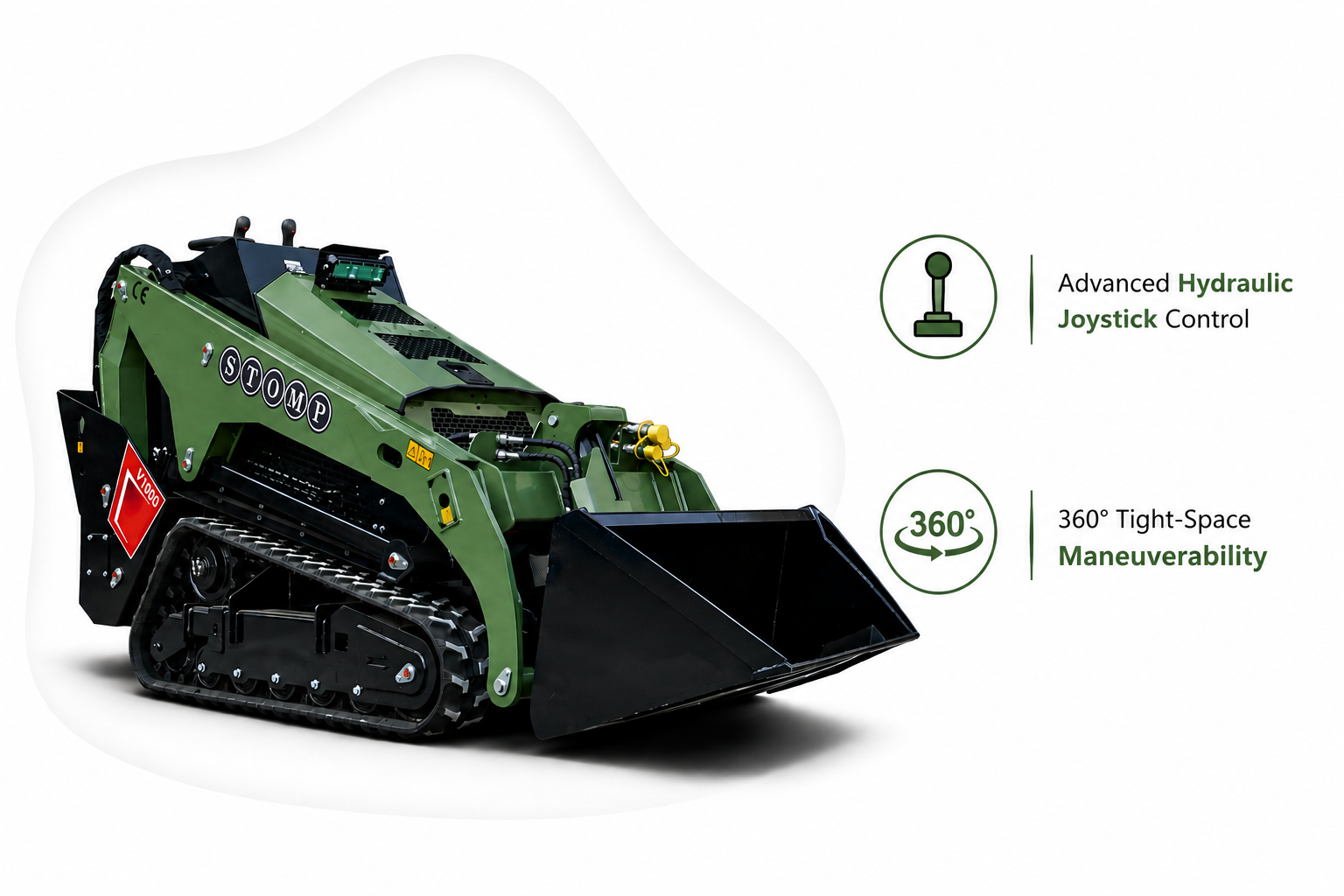
Compact loaders do work perfectly for highly specific situations. If you operate primarily in backyards with narrow gate access, work on rooftops or upper floors, do small landscaping jobs under 50 cubic yards, or face strict job site weight restrictions, these conditions absolutely justify the purchase. If you fall into this exact category, opting for a highly capable and cost-effective unit like the Brand New TYPHON STOMP X1300 can help you offset the high initial expenses while still fitting into tight spaces.
However, do not buy a compact unit for general construction, heavy excavation, grading, or demolition. The hidden costs of a mini skid steer will destroy your profit margins. Full-size owners never pay these bills because their machines are built for high-volume output.
How to Avoid These Extra Expenses
If your main focus is heavy dirt-moving, buy a full-size machine first. Operate it for two years and track your costs per hour. Most contractors realize they never actually needed a compact unit. The one exception is rental: Rent small equipment for the specific job that requires a small footprint. Pay the $200 to $400 rental fee, then go straight back to your full-size machine. This is the smart contractor move.
✅ Your Action Plan
- Calculate your expenses: Find out your cost per cubic yard this week.
- Compare rates: Contrast it with full-size machine rates in your area. If yours is higher, you are losing money.
- Test the waters: Rent a full-size machine for one week and track your productivity difference.
- Make the switch: If you own a compact unit and it’s costing you too much, sell it before the 800-hour mark to maximize your resale value.
Hidden costs of a mini skid steer are completely real. Full-size owners never pay them, and with the right strategy, you don’t have to either.